Our CSR Commitments
Concrete, Measured and Documented Proof
At SEGEDE, environmental and social responsibility is not a statement :
it is built on measured industrial processes, certified partnerships, and verifiable data.
Spécialiste des solutions de bouchages et d’accessoires en métal
At SEGEDE, environmental and social responsibility is not a statement :
it is built on measured industrial processes, certified partnerships, and verifiable data.
At SEGEDE, environmental and social responsibility is not a statement :
it is built on measured industrial processes, certified partnerships, and verifiable data.
Thanks to an eco-design approach, we optimize the weight of each component – for example by designing them as hollow, two-part structures – while preserving the expected aesthetics and quality.
Metals offer the advantage of being recyclable in a closed-loop system, making it possible to incorporate a high proportion of post-consumer and pre-consumer recycled materials (PCR). Whether in aluminum, zamak or brass, this circularity results in a reduced CO₂ footprint per component.
The use of the Zamak recyclability symbol “ZP5” guarantees full control over the product’s end-of-life, ensuring it is reintegrated into its recycling loop.
Green’Zl® is our responsible Zamak bar, designed to guide our clients toward the most efficient material choices in terms of environmental impact, recyclability and durability.
The Zamak commonly used in our products contains 90% recycled material. Its carbon footprint is calculated here based on zinc produced within the European Union, resulting in a reduced environmental impact thanks to the European energy mix, which is greener than the global average for primary zinc production.
Zamak made from 100% recycled material sourced in Europe has the lowest carbon footprint. However, its use results in higher packaging costs due to the increased price associated with sourcing recycled materials.
The Zamak with the highest carbon footprint in this analysis is composed of 90% recycled material and 10% primary zinc sourced from global production. The data used here comes from the Ecoinvent database, which provides carbon footprint values only for primary zinc at a global level.
ZL5 Zamak composed of 100% global primary zinc emits 362.4 kg CO₂ per tonne. Recycled Zamak can be sourced outside the EU, but with a slightly higher carbon footprint due to a less favorable energy mix.
The Zamak commonly used in our products contains 90% recycled material. Its carbon footprint is calculated here based on zinc produced within the European Union, resulting in a reduced environmental impact thanks to the European energy mix, which is greener than the global average for primary zinc production.
Zamak made from 100% recycled material sourced in Europe has the lowest carbon footprint. However, its use results in higher packaging costs due to the increased price associated with sourcing recycled materials.
The Zamak with the highest carbon footprint in this analysis is composed of 90% recycled material and 10% primary zinc sourced from global production. The data used here comes from the Ecoinvent database, which provides carbon footprint values only for primary zinc at a global level.
ZL5 Zamak composed of 100% global primary zinc emits 362.4 kg CO₂ per tonne. Recycled Zamak can be sourced outside the EU, but with a slightly higher carbon footprint due to a less favorable energy mix.
#1
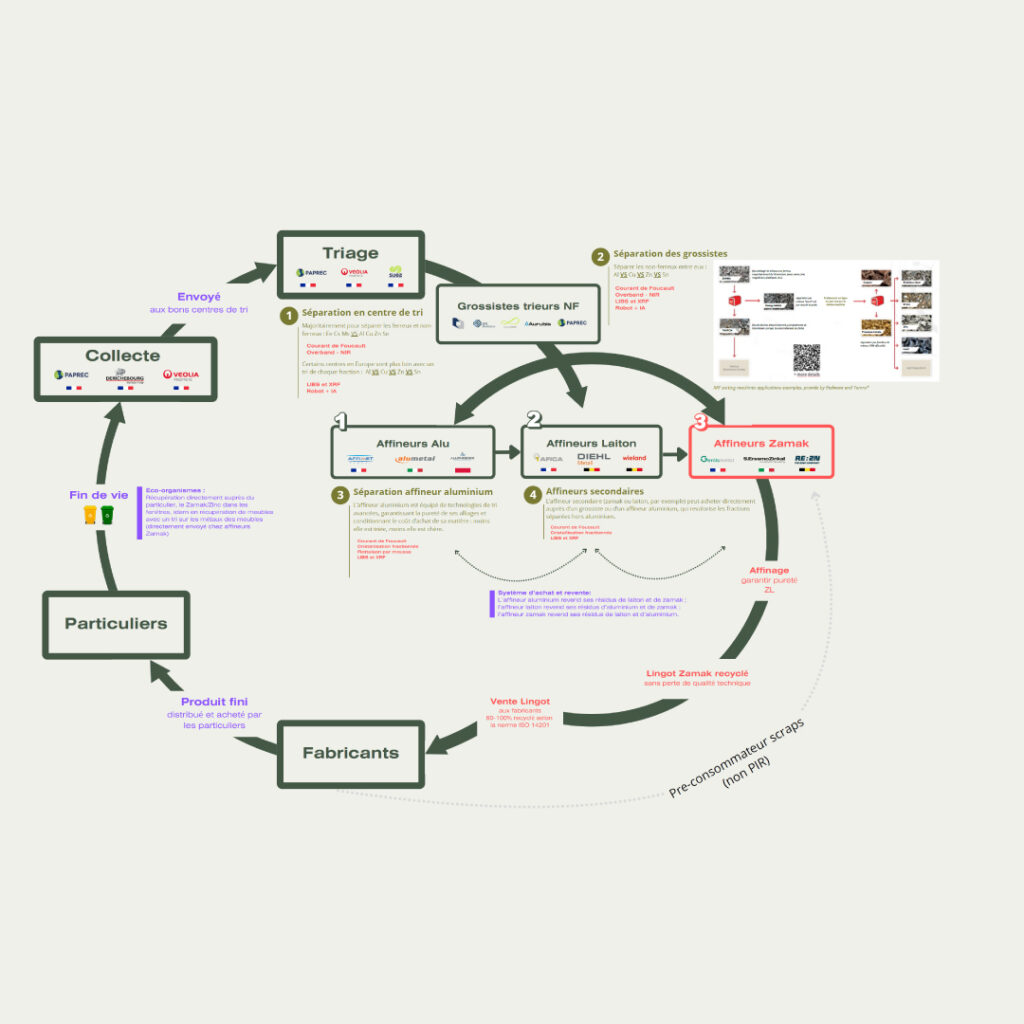
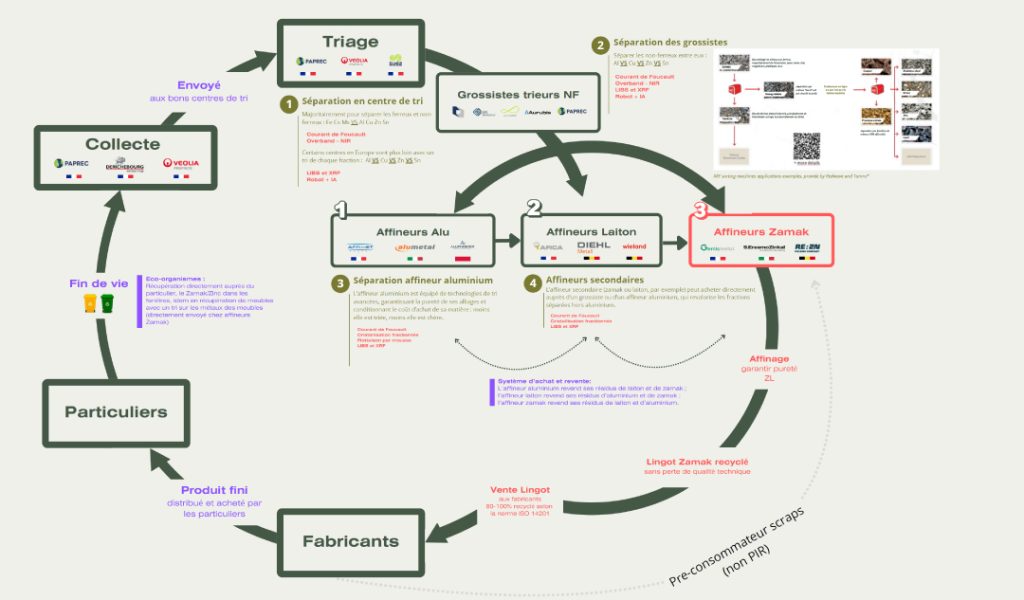
SEGEDE has committed to mapping non-ferrous metal recycling streams to demonstrate their ability to be efficiently collected, sorted, and separated—particularly through eddy current separation and optical sorting technologies (LBS)—achieving over 98% purity and efficiency.
Our work has been adopted and validated by the CEN as well as by the eco-organizations CITEO and LEKO in their recyclability guidelines, which now classify aluminum and Zamak as fully recyclable within the context of packaging recycling.
#1
SEGEDE has committed to mapping non-ferrous metal recycling streams to demonstrate their ability to be efficiently collected, sorted, and separated—particularly through eddy current separation and optical sorting technologies (LBS)—achieving over 98% purity and efficiency.
Our work has been adopted and validated by the CEN as well as by the eco-organizations CITEO and LEKO in their recyclability guidelines, which now classify aluminum and Zamak as fully recyclable within the context of packaging recycling.
#1
SEGEDE has committed to mapping non-ferrous metal recycling streams to demonstrate their ability to be efficiently collected, sorted, and separated—particularly through eddy current separation and optical sorting technologies (LBS)—achieving over 98% purity and efficiency.
Our work has been adopted and validated by the CEN as well as by the eco-organizations CITEO and LEKO in their recyclability guidelines, which now classify aluminum and Zamak as fully recyclable within the context of packaging recycling.
#2
Our processes and materials comply with current regulations, notably CEN (European Committee for Standardization) frameworks.
SEGEDE guarantees the integration of PCR (Post-Consumer Recycled) content in its metals and compliance with the requirements of the European PPWR regulation.
#2
Our processes and materials comply with current regulations, notably CEN (European Committee for Standardization) frameworks.
SEGEDE guarantees the integration of PCR (Post-Consumer Recycled) content in its metals and compliance with the requirements of the European PPWR regulation.
#3